May 18, 2026 • Marisol Vane • 9 min reading time • Prices verified June 4, 2026
Picky Eater Strategy: Wet Food Toppers, Broths, and Shreds That Rebuild Kibble Enthusiasm
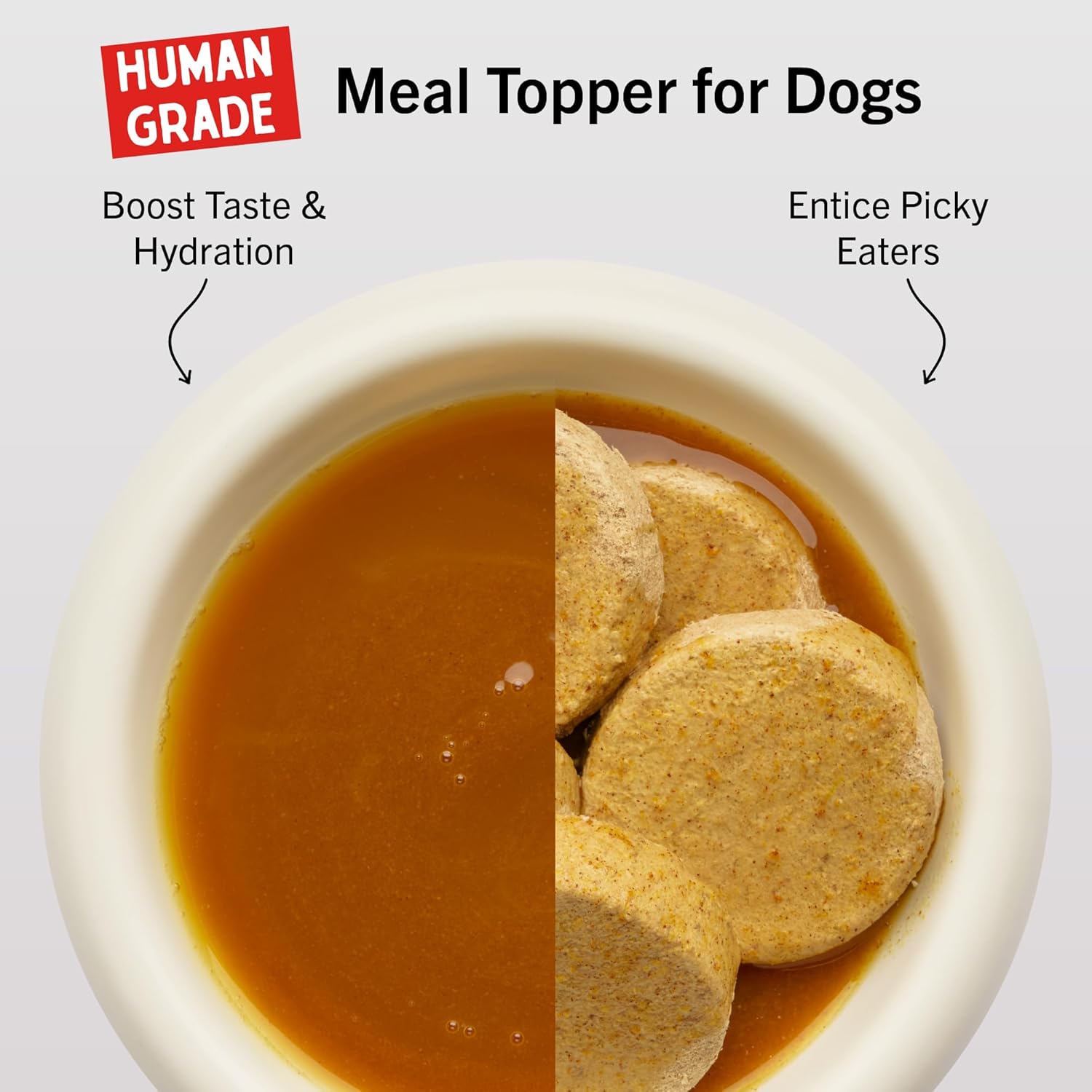
If your dog has started circling the bowl, sniffing once, and walking away — you’re not imagining it, and you’re probably not feeding them bad food. “Picky eating” in dogs is the term for when a dog who ate reliably begins refusing meals or eating only reluctantly, with no underlying illness driving it. It’s one of the most common complaints veterinary nutritionists hear, and the solution almost never requires tossing a full bag of kibble and starting over. What it usually requires is a bridge — something added on top of the dry food (called a topper) that re-engages the dog’s interest through aroma, texture, or palatability (how appealing food tastes and smells to a dog). This article breaks down which topper formats actually work, how to use them without wrecking your dog’s calorie balance, and the decision rules that separate a quick fix from a long-term strategy.
First: Rule Out Medical Before You Optimize Palatability
This is the step practitioners skip at their peril. Tufts University’s Cummings Veterinary Medical Center — in their “Your Dog” resource — explicitly flags that sudden food refusal, especially in a dog who previously ate well, warrants a vet check before any dietary intervention. Dental pain, nausea from kidney disease, GI motility issues, and even early orthopedic pain (a dog may associate standing at a bowl with discomfort) all present as apparent pickiness.
The working threshold: If the refusal started abruptly, has lasted more than 48–72 hours, or comes with any other symptom — weight loss, vomiting, lethargy, changes in water intake — rule out medical first. If the dog eats enthusiastically when hand-fed or when the food is warmed, that’s behavioral/palatability territory and toppers are the right tool. PetMD’s guidance on food refusal makes the same triage call: behavioral picky eaters will typically eat when sufficiently motivated; medically compromised dogs won’t.
Once you’re confident you’re working a palatability problem, the topper toolkit becomes genuinely useful.
The Three Topper Formats and What Each One Actually Does
1. Wet Food Toppers (Pâté or Loaf-Style Canned Food)
A small spoonful of canned food — typically a pâté or loaf-style wet food — added to the top of the kibble bowl is the most common entry point. The mechanism is straightforward: moisture content in wet food is typically 70–80%, compared to kibble’s 8–12%. That moisture carries volatile aromatic compounds to the surface of the bowl, making the meal smell dramatically more interesting to a dog whose olfactory sensitivity is estimated at 10,000–100,000 times that of a human (per VCA Animal Hospitals’ overview of canine nutritional physiology).
What to look for on the label: AAFCO (the Association of American Feed Control Officials, the body that sets minimum nutritional standards for pet food in the U.S.) nutritional adequacy statements. A wet food used as a topper doesn’t need to be “complete and balanced” on its own — it’s not the diet — but if you’re using it with any regularity, you want it to be at minimum “complementary” quality rather than something that would dilute the kibble’s nutrient profile significantly. Whole Dog Journal’s analysis of wet food toppers cautions that high-use toppers (more than 10–15% of total daily calories) from low-quality, high-filler sources can meaningfully skew a diet’s protein and phosphorus ratios.
Portion discipline: This is where most owners overdo it. A topper is meant to comprise 5–10% of the total meal by calorie, not by volume. Because wet food is calorie-sparse relative to kibble (typically 300–450 kcal/kg wet vs. 3,200–4,000 kcal/kg dry), the volume of a topper looks small but displaces more calories than it appears to.
2. Bone Broth and Hydration Toppers
Bone broth formatted for dogs (low sodium, no onion, no garlic — both are toxic to dogs in concentrated forms) works differently than wet food. It contributes almost no calories in typical serving sizes (a 2-oz pour adds roughly 10–20 kcal) but delivers a strong aroma hit and warmth when served slightly heated. For dogs who are volume-sensitive — who stop eating when the bowl looks “too full” — broth is the cleaner tool than wet food because it doesn’t meaningfully change the meal’s calorie load.
Products like Brutus Broth and Primalvore are formulated specifically for dogs and are widely reviewed by owners as reliable palatability enhancers. Reviewers across aggregated purchase data consistently note that warming the broth to just above room temperature (around 100–105°F) before pouring produces better results than serving cold — this tracks with the basic food science of volatile aromatic release at higher temperatures.
The caution on human bone broth: Most commercial human broths are too high in sodium and frequently contain alliums (onion, leek, shallot family) in amounts that accumulate to toxic thresholds with repeated use. If you’re using human broth in a pinch, it needs to be low-sodium, confirmed allium-free, and not a regular substitution.
3. Shredded Proteins and Freeze-Dried Toppers
Shredded cooked chicken breast, turkey, or white fish served plain (no seasoning, no marinade) is the practitioner community’s go-to for the most stubborn cases — dogs who won’t respond to scent alone but will eat around kibble to get to meat. The behavioral psychology here matters: if you’re not careful, you’re training the dog that refusing kibble produces a better outcome (more meat), which deepens the pickiness over time.
The strategic use of shreds is therefore as a mixed-in component rather than a layer on top. When the dog can’t physically separate the interesting bits from the kibble, the kibble gets eaten too. This technique is documented in behavior-focused nutritional discussions, including in Whole Dog Journal’s coverage of mealtime motivation.
Freeze-dried toppers — from brands like Stella & Chewy’s, Primal, and Northwest Naturals — function similarly but with lower prep burden. They’re raw meat that has been freeze-dried (moisture removed at low temperature to preserve nutrients), then crushed or crumbled. Owners in long-term reviews consistently report that small amounts (a tablespoon or two crumbled over the bowl) produce outsized palatability lift relative to calorie addition. Published spec sheets for most freeze-dried toppers put them at roughly 50–70 kcal per tablespoon — so still worth tracking if your dog is weight-sensitive.
The Calorie Math You Actually Need
The number practitioners miss most often is RER — Resting Energy Requirement, the baseline calorie need for a dog at rest, calculated as 70 × (body weight in kg)^0.75. MER (Maintenance Energy Requirement) adds an activity multiplier on top of RER. These numbers matter because topper calories are easy to forget when they’re “just a little extra.”
By the numbers:
| Dog weight | RER (kcal/day) | MER estimate (moderately active, ×1.6) | 10% topper budget |
|---|---|---|---|
| 10 kg (22 lb) | ~310 kcal | ~496 kcal | ~50 kcal |
| 25 kg (55 lb) | ~590 kcal | ~944 kcal | ~94 kcal |
| 40 kg (88 lb) | ~840 kcal | ~1,344 kcal | ~134 kcal |
A 2-tablespoon dollop of pâté-style wet food is roughly 30–50 kcal. A 2-tablespoon crumble of freeze-dried topper runs 100–140 kcal. For a 10 kg dog, that freeze-dried crumble eats nearly the entire topper budget before you’ve adjusted kibble volume. Reduce kibble accordingly — or you’re running a caloric surplus and rebuilding a different problem.
Building a Rotation That Doesn’t Create Dependence
This is the strategic layer most topper guidance skips. The risk with any palatability intervention is habituation — the dog escalates demands, refusing meals unless the topper is present, then refusing meals unless the new topper is present. The Tufts “Your Dog” resource addresses this explicitly: feeding from a place of anxiety about whether the dog will eat tends to produce dogs who leverage that anxiety.
The rotation protocol that avoids this:
- Choose 2–3 topper types from different format categories (e.g., a wet food, a broth, and a freeze-dried protein) and rotate without a pattern the dog can predict.
- Set a meal window — 15–20 minutes, food down, then up regardless of consumption. This prevents grazing and reinforces that meals are events with endings.
- Phase the topper out periodically — run 2–3 days without any topper every few weeks to recalibrate baseline kibble acceptance. If the dog eats cleanly without the topper during these windows, you’re maintaining elasticity.
- Never add more topper in response to refusal at a given meal. If the dog doesn’t eat, the bowl goes up. The next meal is offered fresh. Escalating the topper in response to rejection is the behavior chain that creates a truly difficult picky eater.
If X, Then Y: The Decision Rules
-
If the dog is refusing kibble but eats enthusiastically when hand-fed or when the food is warmed: Start with broth warming the kibble. This is a palatability-only issue with a low-cost solution. No significant calorie adjustment needed.
-
If the dog eats the topper and leaves kibble behind: Switch from layered/top-application to mixed-in shreds or fine-crumbled freeze-dried. Remove the ability to pick through.
-
If the dog has been on the same kibble for 12+ months and refusal is new: Rule out a formula change by the manufacturer (brands reformulate without prominent announcements — Dog Food Advisor’s manufacturer tracking is a useful watchlist resource) and consider whether the bag or lot has a quality issue.
-
If refusal is selective by time of day (eats breakfast but not dinner, or vice versa): The issue is often exercise timing, heat, or routine disruption rather than palatability. Toppers won’t fix a scheduling problem.
-
If the dog is weight-stable or underweight and the goal is calorie addition alongside palatability: Higher-calorie wet food toppers (not broths) at 10–15% of MER are appropriate, but choose options with AAFCO complete-and-balanced statements to avoid nutrient dilution at that use level.
-
If you’re working multiple dogs at volume (kennel or training facility context): Freeze-dried toppers scale cleanly — shelf-stable, consistent calorie density per tablespoon, no refrigeration waste. The cost-per-use math typically favors larger format bags (16 oz+) from Stella & Chewy’s or Primal over single-serve pouches by a factor of 2–3×.
The bottom line: most picky eaters are solvable without a full diet switch, and usually without expensive interventions. Pick the topper format that matches the mechanism of refusal, do the calorie math before you pour, and build in scheduled topper-free meals from the start. That’s the strategy that rebuilds enthusiasm without building dependence.