April 17, 2026 • Marisol Vane • 9 min reading time • Prices verified June 4, 2026
Slow Feeder Bowls vs. Puzzle Feeders: Matching the Tool to Your Dog's Gulping Problem
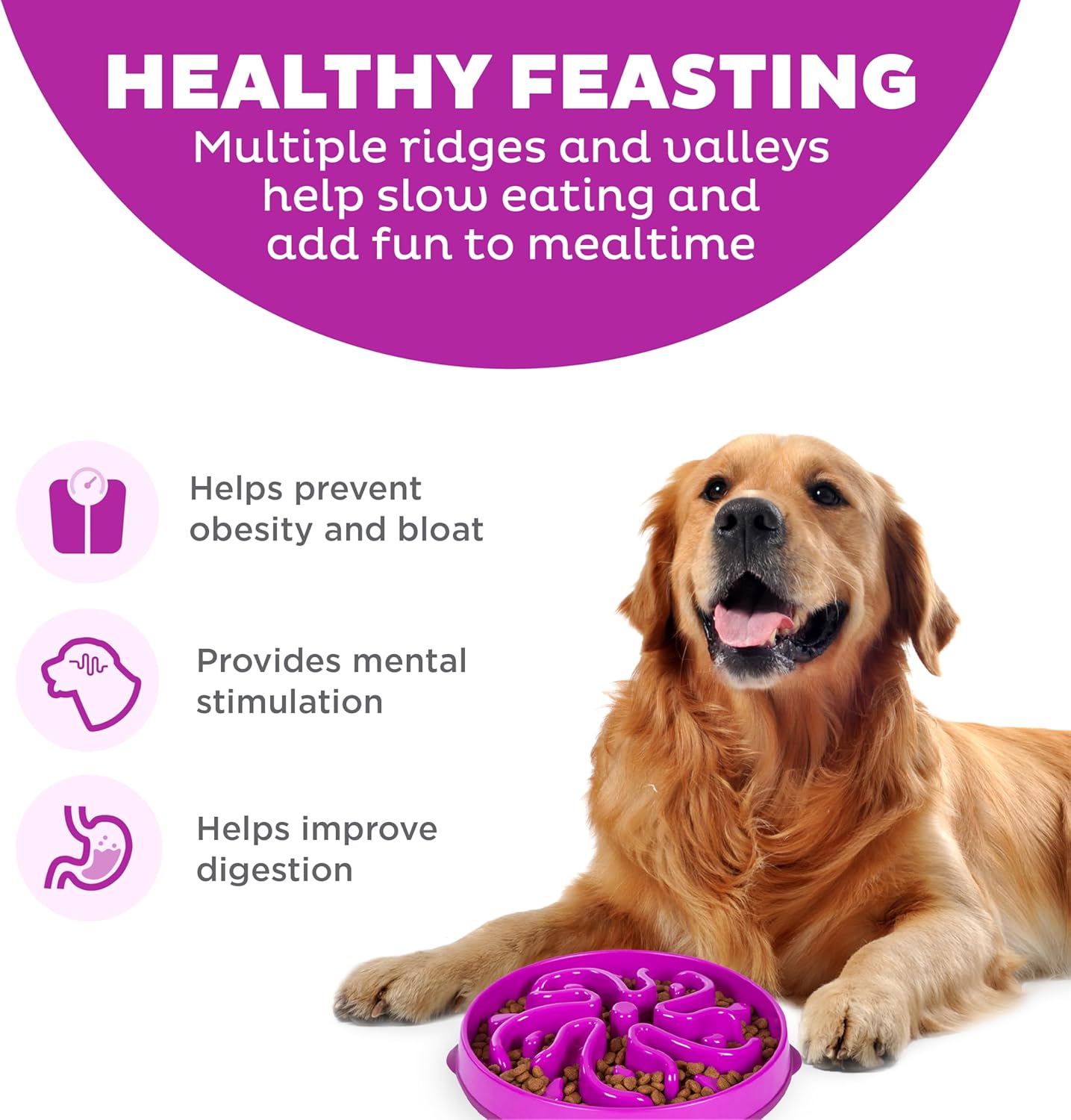
If your dog inhales their meal in under 30 seconds and then stands over an empty bowl looking vaguely affronted, you already know the problem. Fast eating — technically called food bolting — isn’t just a quirk. Dogs that eat too quickly swallow large amounts of air alongside their food, which can cause discomfort, vomiting, and in large or deep-chested breeds, a potentially life-threatening condition called gastric dilatation-volvulus (GDV), where the stomach fills with gas and twists on itself. According to the American Kennel Club’s “Bloat in Dogs” health overview (akc.org), deep-chested breeds like Great Danes, German Shepherds, Standard Poodles, and Weimaraners face meaningfully higher GDV risk — but any dog that bolts food can benefit from slowing down.
Two product categories address this: slow feeder bowls (bowls with raised ridges or maze-like surfaces that physically obstruct the dog’s tongue and muzzle) and puzzle feeders (interactive toys or trays that require the dog to manipulate covers, sliders, or compartments to access food). Both work, but they work differently, suit different dogs, and fail in different ways. This guide breaks down the decision frame so you can stop buying the wrong tool for your dog’s specific gulping pattern.
What You’re Actually Solving: Diagnosing the Gulping Pattern
Before picking a product category, identify why your dog is eating fast. The fix isn’t identical across cases.
Competitive anxiety is the most common driver — especially in multi-dog households or dogs with shelter histories. The dog believes food will disappear or be taken. Puzzle feeders can help here because the required engagement changes the dog’s relationship with the meal: it becomes a task, not a race.
Boredom or low arousal dogs often bolt because eating is one of the few stimulating events in their day. For these dogs, a puzzle feeder doubles as enrichment. Whole Dog Journal’s editorial coverage of puzzle feeders and food-dispensing toys notes that food-based work engages problem-solving behavior and can meaningfully reduce anxiety-driven patterns — bolting included.
Breed- and anatomy-driven gulping is different. Flat-faced (brachycephalic) breeds like Bulldogs and French Bulldogs gulp air structurally; their shortened airways mean they cannot breathe and swallow efficiently at the same time. For these dogs, VCA Hospitals’ clinical overview of gastric dilatation and volvulus (vcahospitals.com) recommends mechanical meal-slowing through bowl design over enrichment complexity, because a puzzle’s tight compartments may frustrate rather than slow a dog with anatomical restrictions.
High-drive working or sport dogs often eat fast as a byproduct of arousal state — they’re always at 80% intensity. For this cohort, a puzzle feeder’s delay mechanism is often more effective than a bowl obstacle because it channels drive into a structured problem rather than just physically impeding the gulp.
The diagnostic question: Is this a behavior problem, an anatomy problem, or a management problem? That answer routes you to the right tool category.
Slow Feeder Bowls: What the Specs Actually Mean
Slow feeder bowls work by reducing the “shovel surface” — the usable flat area from which a dog can scoop kibble. The ridges, spirals, or raised columns force the tongue to work around obstacles, extending meal time from under a minute to three to five minutes in most cases.
Budget Slow Feeder Bowls
Entry-level slow feeders in the $8–$18 range, such as the Outward Hound Fun Feeder and the Northmate Green, perform comparably to premium versions for most dogs based on published design logic. The core mechanism — raised posts or maze ridges in food-grade plastic — is functionally identical to more expensive options. The tradeoff is material longevity. Reviewers at Canine Journal consistently note that the standard difficulty settings on most popular bowls in this tier are quickly solved by medium-to-large dogs with any prior puzzle experience, and lightweight plastic without an anti-slip base gets shoved across the floor within seconds by determined dogs, defeating the obstacle design entirely.
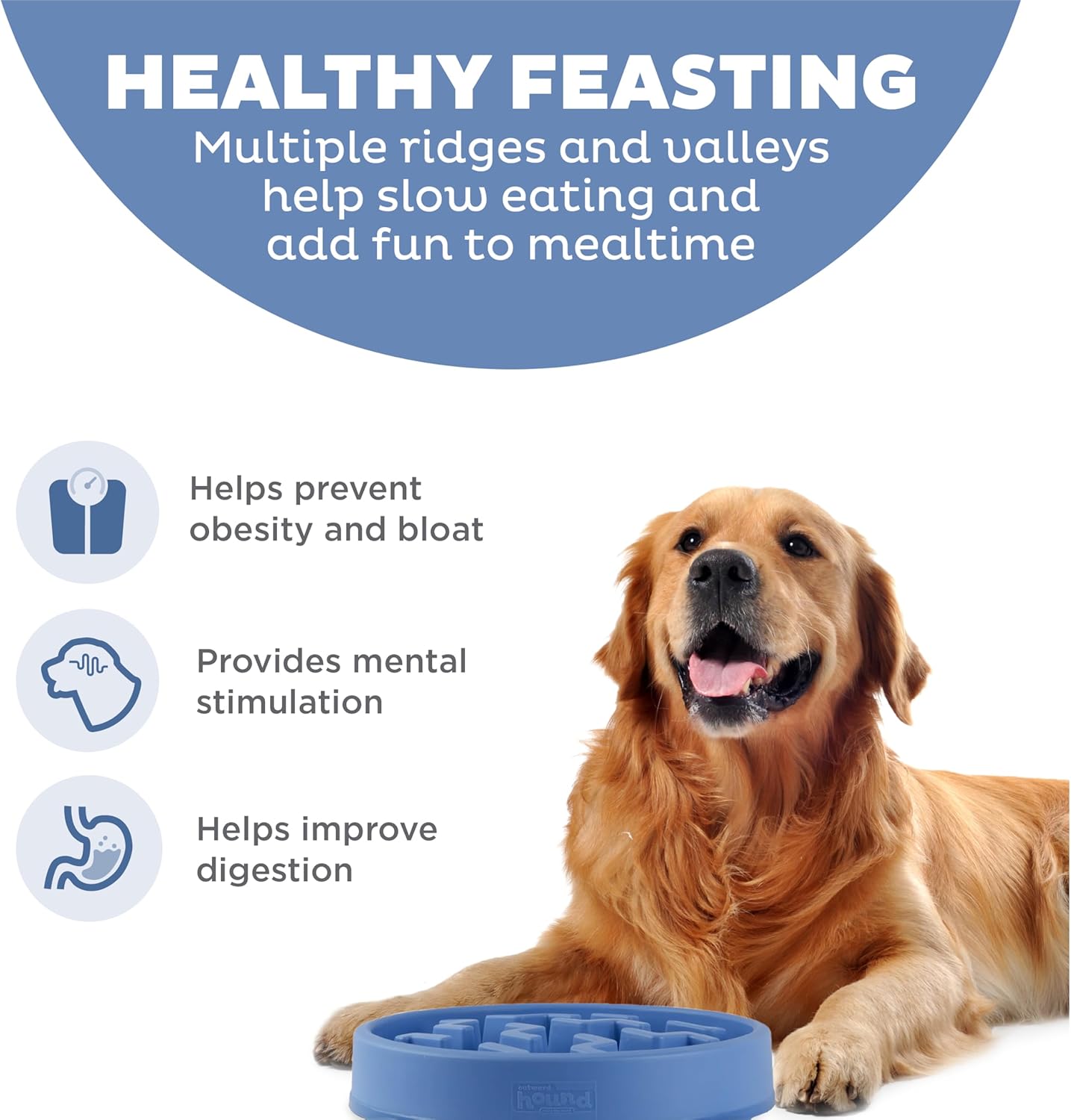
Outward
$11.96
In stock on Amazon
Check price on AmazonMid-Tier Slow Feeder Bowls
In the $20–$35 range, bowls begin to offer rubberized bases, tighter maze geometries, and more durable plastics rated for repeated dishwasher cycles. This tier is the practical sweet spot for single-dog households. The anti-slip base is the single most impactful upgrade from the budget tier — owners consistently report that bowls without it are neutralized by a dog who simply pushes the bowl into a corner and eats normally from the rim. A key spec to check: obstacle height and spacing relative to muzzle length. A Collie or Vizsla with a narrow, deep muzzle can navigate most standard obstacle patterns easily — these dogs need tighter spacing or a lick-mat format. A short-muzzled Frenchie needs shallower, wider-spaced obstacles. Manufacturers rarely publish exact obstacle height in millimeters, so consulting Canine Journal’s breed-specific slow feeder reviews is useful before purchasing.
Outward
$15.25
In stock on Amazon
Check price on AmazonPremium Slow Feeder Bowls
At $30–$50 and above, stainless steel options — such as those in the OurPets Durapet range — offer the sanitation reliability that plastic cannot match at volume. Stainless versions survive high-temperature dishwasher cycles without warping, which matters for multi-dog facilities, boarding operations, and households sanitizing daily. The VCA Hospitals GDV clinical overview emphasizes that for high-risk large and deep-chested breeds, the consistency of mechanical meal-slowing is more important than any single design feature — and stainless construction ensures the bowl retains its geometry and surface integrity over years of use where plastic may crack or warp. Premium does not mean meaningfully better slowing performance; it means durable, sanitation-grade performance that holds up to institutional use.
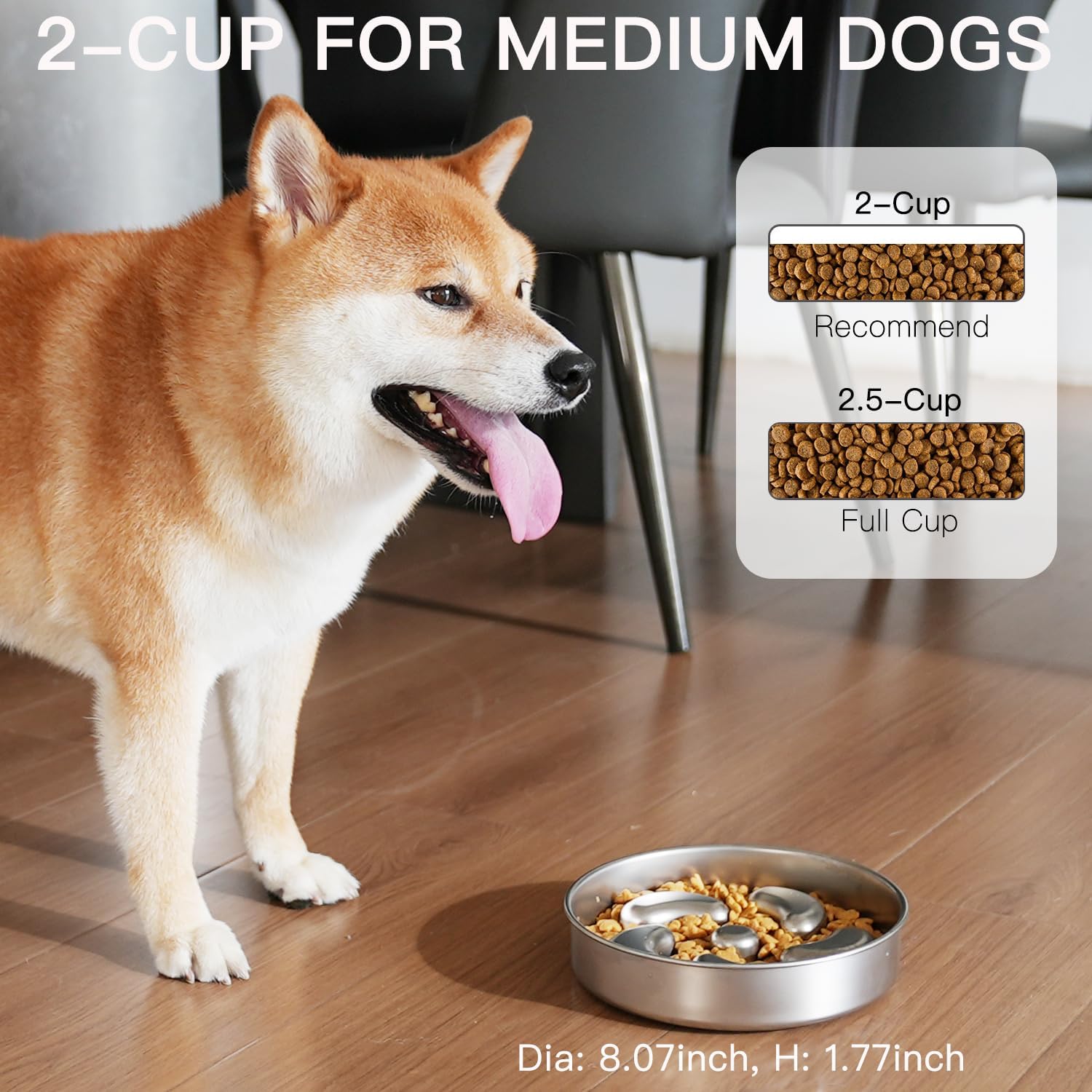
Slow
$25.64
In stock on Amazon
Check price on AmazonPuzzle Feeders: Complexity Tiers and Where They Break Down
Puzzle feeders introduce a cognitive layer: the dog has to figure out the mechanism before eating. The enrichment benefit is real, but the tradeoff is setup time, cleaning complexity, and a learning-curve risk — a dog that cannot solve the puzzle at first may give up, knock the toy over, or stop eating, which is a legitimate welfare concern for underweight or anxious dogs.
Budget Puzzle Feeders
Cheap unbranded puzzles — often imported with no published material specifications — frequently have sharp mold seams, non-food-grade plastics, and wobbly mechanisms that fail within a month. Canine Journal’s review coverage of food-dispensing toys notes that this tier often defeats itself: a puzzle that wobbles or tips during the first session teaches the dog to batter the toy rather than engage with the mechanism, which is the opposite of the intended behavioral outcome. If budget is the constraint, a Level 1 lick mat (flat silicone surface, widely available for under $10) is a more reliable choice than a low-quality compartment puzzle.
Outward
$11.96
In stock on Amazon
Check price on AmazonMid-Tier Puzzle Feeders
The Nina Ottosson by Outward Hound line is the most widely cited example of tiered puzzle design in the enrichment community and is covered extensively in Whole Dog Journal’s puzzle feeder editorial coverage. The Dog Brick and Tornado sit at Level 1–2 complexity (simple sliding covers and lift-off cups); the Dog Worker and Dog Casino sit at Level 2–3. The $20–$35 price range for this line reflects consistent food-grade material quality, published complexity ratings, and replaceable parts — a meaningful durability advantage over unbranded alternatives. Tufts Your Dog’s coverage of canine enrichment notes that dogs regularly exposed to the same puzzle solve it progressively faster, eventually reducing it back to a fast meal. Rotation across three to four puzzles at different complexity levels is the standard practitioner recommendation to maintain cognitive load, making the mid-tier price point reasonable given you’ll likely need multiple units.
Outward
$15.25
In stock on Amazon
Check price on AmazonPremium Puzzle Feeders and Multi-Use Systems
For high-drive or sport dogs, the Kong Classic and Toppl combination system — used as a combined puzzle and slow feeder by stuffing with kibble and wet food — achieves the same cognitive engagement as a flat puzzle at significantly higher durability. It scales from Level 1 (loose kibble, easy extraction) to Level 3 (frozen, layered stuffing requiring sustained manipulation) without buying separate products. PetMD’s coverage of canine digestive health notes that for raw-fed or fresh-fed dogs, surface hygiene is a non-negotiable daily task, and the Kong system’s smooth interior surfaces are substantially easier to sanitize than the grooved compartments of flat puzzle designs, which trap moisture and support bacterial growth. For raw or wet food applications, this makes the premium multi-use system the only puzzle-format option worth considering at daily feeding frequency.
Slow
$25.64
In stock on Amazon
Check price on AmazonThe Decision Frame: If X, Then Y
Here is where the two categories separate cleanly:
If the primary goal is GDV risk reduction in a large or deep-chested breed → slow feeder bowl, raised slightly (4–6 inches off the floor), with an anti-slip base. The physical impediment is consistent and requires no training. The VCA Hospitals GDV clinical overview emphasizes mechanical meal-slowing over behavioral modification for high-risk breeds.
If the dog has competitive anxiety in a multi-dog household → puzzle feeder at Level 1–2 complexity, fed in a separate room. The spatial and cognitive separation reframes feeding as individual problem-solving, not competition.
If the goal is enrichment alongside slowing → puzzle feeder, rotated on a three-to-four-toy cycle. Budget for at least three products at varying complexity levels; a single puzzle becomes ineffective within two to three weeks for a cognitively engaged dog.
If the dog is brachycephalic → shallow-ridge slow feeder bowl or lick mat. Avoid puzzle compartments with tight covers that require sustained muzzle pressure. VCA Hospitals’ GDV overview reinforces that anatomical restrictions warrant bowl-design solutions over enrichment complexity.
If you’re feeding wet, raw, or fresh food → lick mat (technically a slow feeder subcategory) with a textured silicone surface. Reserve complex puzzle mechanisms for kibble-based enrichment treats; the hygiene risk from wet food in grooved compartments, as noted in PetMD’s canine digestive health coverage, is not manageable at daily feeding frequency.
If you’re a trainer, rehabilitation practitioner, or multi-dog facility operator → stock both categories and match to individual intake assessment. For post-surgical or orthopedic patients, lick mats fed at floor level or on a low platform reduce the neck extension stress that traditional bowls impose. For sport dogs in active conditioning, puzzle feeders during rest periods support mental fatigue alongside physical recovery. For senior dogs showing signs of canine cognitive dysfunction, the American Kennel Club’s health resources note that frustration from unsolvable-feeling tasks increases stress-related behavior — in these cases, a simple slow feeder bowl or lick mat is the appropriate choice over any puzzle format.
The bottom line: slow feeder bowls are the reliable, low-maintenance default for GDV risk management and anatomy-driven gulping. Puzzle feeders are the right tool when the problem is behavioral — anxiety, boredom, or excess drive — and when you’re willing to invest in rotation and maintenance. Most dogs who bolt food would benefit from both categories used at different meals. Most owners only need one. Know which problem you’re solving first, and the product decision follows directly.