May 21, 2026 • Marisol Vane • 9 min reading time • Prices verified June 4, 2026
No-Pull Harnesses That Actually Fit Deep-Chested and Short-Backed Dogs
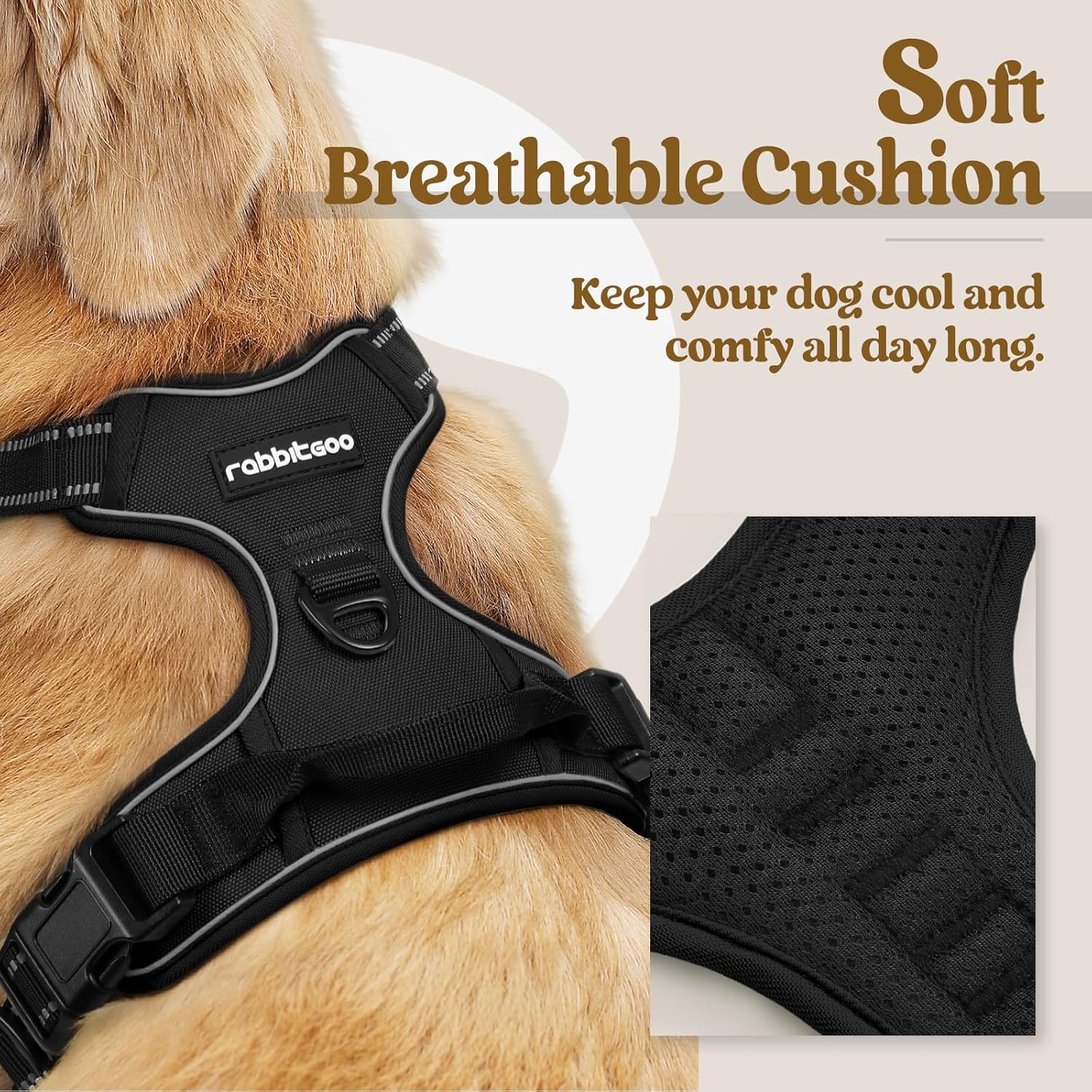
A no-pull harness is exactly what it sounds like: a harness — a webbing or padded strap system that wraps your dog’s chest and torso instead of attaching to a collar around the neck — designed so that when your dog lunges forward, the leash attachment geometry redirects them back toward you rather than rewarding the pull. The problem is that most of these products are engineered around a “generic medium dog” body — something close to a Labrador or Beagle silhouette. If your dog has a deep, narrow chest (think Greyhound, Whippet, Doberman) or a short, compressed back (Bulldog, French Bulldog, Dachshund, Basset Hound), that generic geometry fails quickly and sometimes harmfully: straps migrate into the armpits, the front-clip ring hangs off-center, and the whole system either pops off or restricts shoulder movement in ways that can cause long-term gait problems. This guide is about understanding why standard sizing fails specific body types, what specs to look for, and which products are actually engineered around the geometry that makes these dogs hard to fit.
| EDITOR'S PICK[Carhartt Nylon Duck No Pull Dog](https://www.amazon.com/dp/B0BPDQJ4G4?tag=greenflower20-20)… | Mid-tier[2 Hounds Design Freedom No Pull](https://www.amazon.com/dp/B00A3XS95M?tag=greenflower20-20)… | Budget pick[PHOEPET No Pull Dog Harness Med](https://www.amazon.com/dp/B07GVCFQV6?tag=greenflower20-20)… | |
|---|---|---|---|
| Adjustable points | — | — | 3 buckles |
| Front clip | — | — | ✓ |
| Control handle | ✓ | — | ✓ |
| Reflective | ✓ | — | ✓ |
| Material | Nylon Duck | — | — |
| Color options | Carhartt Brown | Teal | Orange |
| Price | $38.28 | $34.98 | $13.93 |
| See on Amazon → | See on Amazon → | See on Amazon → |
Why Body Geometry Matters More Than Size
When harness manufacturers say “medium,” they’re expressing a girth range — typically the circumference measured just behind the dog’s front legs. That single number captures almost nothing about shape. The two dimensions that actually determine harness fit are:
Chest depth-to-width ratio. A Greyhound and a Bulldog can have nearly identical chest girth measurements while having almost opposite cross-sectional shapes. The Greyhound’s chest is deep (long from spine to sternum) and narrow side-to-side — what breeders and the American Kennel Club’s published breed standards describe as a “deep, capacious chest.” A Bulldog’s chest is wide and shallow by comparison. A harness sternum plate that fits flush on one will gap, rotate, or sit on the shoulder joint of the other.
Back length relative to girth. “Short-backed” breeds — Bulldogs, French Bulldogs, Dachshunds, Basset Hounds — have a compressed distance between the front leg attachment and the hips. A standard Y-harness (two shoulder straps meeting at a Y-junction over the chest) often places its rear strap directly over the last rib or even the lumbar spine on these dogs. Per VCA Animal Hospitals’ documentation on intervertebral disc disease, Dachshunds are already predisposed to spinal compression; a harness rear strap that sits on the lumbar region adds mechanical stress to an already vulnerable anatomy.
The arching sighthound neck. Whippets, Italian Greyhounds, and Greyhounds have necks that arch dramatically from skull to shoulder and then drop steeply into a narrow chest. Harnesses that rely on a fixed neck loop — even generously padded ones — sit either too loose (and rotate) or too tight (and restrict breathing during exertion). The Whole Dog Journal’s coverage of harness fit notes that neck-loop styles are categorically problematic for sighthound-type necks and recommends step-in or overhead designs that bypass the neck-loop entirely.
The Three Harness Architectures and How They Fail (or Don’t)
Y-Front / Roman Harness
The Y-front design — a sternum strap rising to a Y-junction at the chest, with two straps going over each shoulder — is the dominant no-pull architecture. It protects shoulder range of motion better than a traditional H-harness (the box-frame design with a strap across the front of the chest). But the Y requires a minimum back length to place the rear strap correctly, which disqualifies it from most short-backed breeds. On a French Bulldog, even a well-sized Y-front typically ends up with the rear girth strap sitting over the last rib.
Fit verdict for short-backed dogs: marginal to poor. The rear strap must land in the soft abdominal area just forward of the hip bones. If your dog’s back length (measured from the base of the neck to the base of the tail, roughly) is under 10 inches, a Y-front is almost always the wrong architecture.
Step-In / Panel Harness
Step-in harnesses — where the dog steps two paws through two loops and you clip the back — tend to have a lower sternum contact point and a wider, more padded chest panel. For deep-chested sighthounds, this architecture is often the best match because it wraps the narrow chest from the sides rather than relying on a single sternum plate. For very wide-chested dogs (Bulldogs), you need a step-in with a chest panel wide enough to span that girth without rolling.
Fit verdict for sighthound types: often best. Fit verdict for wide-chested short dogs: geometry-dependent; measure the chest panel width against your dog’s sternum width before buying.
Dual-Clip Sport Harness
Dual-clip harnesses — Ruffwear Flagline, Julius-K9 IDC, Hurtta Active — have both a front (sternal) ring and a back ring, letting you choose or split attachment depending on leash setup. These tend to be the most adjustable designs with the most adjustment points (typically 4–6 straps versus 2–3 on entry-level harnesses), which is exactly what you need when you’re working around unusual geometry. The tradeoff is cost and complexity.
Fit verdict for difficult geometries: highest ceiling, highest learning curve. An adjustable dual-clip harness fitted correctly is almost always the best outcome. An adjustable dual-clip harness fitted badly is worse than a simpler design fitted well — more adjustment points mean more things to get wrong.
By the Numbers: Breed Geometry Quick Reference
| Breed Type | Chest Depth | Back Length | Primary Fit Risk | Recommended Architecture |
|---|---|---|---|---|
| Greyhound / Whippet | Very deep, narrow | Medium | Neck loop rotation, shoulder restriction | Step-in or no-neck-loop Y |
| French Bulldog | Moderate depth, very wide | Short | Rear strap on lumbar spine | Short-back step-in or custom |
| Dachshund (Standard) | Deep, narrow-ish | Very short | Rear strap on lumbar/spine | Short-back step-in; avoid Y-front |
| Bulldog (English) | Moderate, very wide | Short | Chest plate too narrow, rotates | Wide-panel step-in |
| Doberman / Weimaraner | Deep, moderate width | Medium-long | Sternum plate too short vertically | Deep-chest Y-front or dual-clip |
Products That Actually Engineer for These Problems
For Sighthound Geometry: Ruffwear Flagline Harness
Ruffwear’s published fit specifications show a notably taller sternum panel on the Flagline compared to their original Front Range, which is what makes it work on deep-chested dogs where the sternum junction sits 4–6 inches below where a shallower dog’s would. The design routes the load-bearing webbing (Ruffwear spec sheets list 1-inch, 1,000-denier — denier being a measure of webbing thread density, where higher numbers mean more abrasion resistance — nylon webbing on the structural straps) around the ribcage rather than over the shoulder blades. Owners of Dobermans and Weimaraners in aggregated reviews consistently report that the Flagline is the first harness that stopped migrating toward the armpits during a 5-mile run.
It is not cheap: retail runs $89–$109 depending on size as of mid-2026. But if you’ve already bought and returned two $30 harnesses, the cost-per-use math favors starting here.
For Short-Backed Dogs: Ruffwear Webmaster
The Webmaster — Ruffwear’s five-point adjustable harness — was originally designed for search-and-rescue dogs that need to be physically lifted. The consequence of that design brief is a rear strap placement that sits significantly further forward on the torso than any standard Y-front, because it has to clear the hindquarters for lifting. For Bulldogs, French Bulldogs, and Basset Hounds, this unintentionally solves the lumbar problem. Canine Journal’s roundup of no-pull harnesses identifies the Webmaster as one of the few designs that fits brachycephalic (flat-faced, wide-chested) breeds without requiring custom modification.
At $89–$109 retail, it’s in the same price tier as the Flagline. Worth noting: it is heavier and warmer than other options — not ideal for summer-weather dogs that run hot, which includes many Bulldogs.
For Dachshunds and Long-Low Dogs: Julius-K9 IDC Powerharness (Small / Mini)
Julius-K9’s IDC Powerharness has a shorter back span in its smaller sizes than comparable designs, and the chest plate is genuinely padded and contoured for narrow-to-moderate chest widths. The manufacturer’s published documentation emphasizes the adjustable belly strap that can be moved forward on the torso — critical for placing the girth strap ahead of the lumbar spine on a short-backed dog. Per VCA’s documentation on IVDD risk factors in Dachshunds, any equipment that reduces spinal load-bearing matters clinically, not just for comfort.
The reflective handle and velcro patch system are bonuses for sport-dog handlers who want identification panels. Owners in long-run reviews report the velcro tabs wearing at 18–24 months of daily use — worth budgeting for replacement.
For Wide-Chested Bulldogs: Hurtta Active Harness
Hurtta’s published specs include chest panel widths that run 15–20% wider than comparable Ruffwear sizes at the same girth measurement — which tracks with Hurtta’s Scandinavian design brief around Nordic and large-breed body types, but also happens to solve the English Bulldog’s wide, flat chest. The Active Harness uses a step-in entry that keeps the neck loop optional and adjustable, and the sternum panel is shorter vertically, which avoids the common failure mode of a tall sternum plate pressing into a Bulldog’s short neck.
Hurtta’s pricing sits at $70–$90 depending on size. Reviewers consistently flag the fit as requiring careful initial setup — specifically, the rear girth strap needs to be tightened more than feels intuitive for the harness to stop rotating.
Measuring Correctly: The Two Numbers That Actually Matter
Standard sizing charts ask for neck and chest girth. For the breeds discussed here, you need two additional measurements:
-
Back length: Base of neck (where collar would sit) to base of tail, measured along the spine with the dog standing square. This is your primary filter for whether a Y-front architecture is viable.
-
Chest depth: Crown of withers (top of shoulder blade) straight down to sternum, measured with the dog standing. A measurement over 10 inches on a medium-girth dog signals sighthound-type geometry and a need for a taller sternum panel.
Take both measurements with a soft tape and the dog standing relaxed — not sitting, which compresses the back and inflates the chest depth reading.
The Decision Rule
If your dog’s back length is under 10 inches: Eliminate all standard Y-front designs. Start with the Ruffwear Webmaster or Julius-K9 IDC in small sizes. Confirm rear strap placement is landing on the soft belly, not the ribs or lower spine, before the first walk.
If your dog’s chest depth exceeds 10 inches on a medium-girth frame: You have a sighthound or deep-chest type. The Ruffwear Flagline is the spec-matched starting point. Rule out any harness with a fixed neck loop.
If your dog is wide-chested and short-backed simultaneously (English Bulldog, Olde English Bulldogge): Measure the sternum width in addition to girth, compare it to the manufacturer’s chest panel width spec, and treat the Hurtta Active as the primary candidate. Budget for a 20-minute initial fitting session — this geometry punishes fast, casual setup more than any other.
For all three types, the Whole Dog Journal’s guidance on harness fit holds as a baseline check: after fitting, you should be able to slide two fingers under every strap, the harness should not shift more than half an inch in any direction when the dog shakes, and the dog’s front legs should move through a full range of motion without the sternum panel rising toward the neck. If any of those three checks fail, the architecture is wrong for the body — not the size.