April 16, 2026 • Marisol Vane • 8 min reading time • Prices verified June 4, 2026
Why the Handle on Your Large Dog Harness Matters More Than the D-Ring
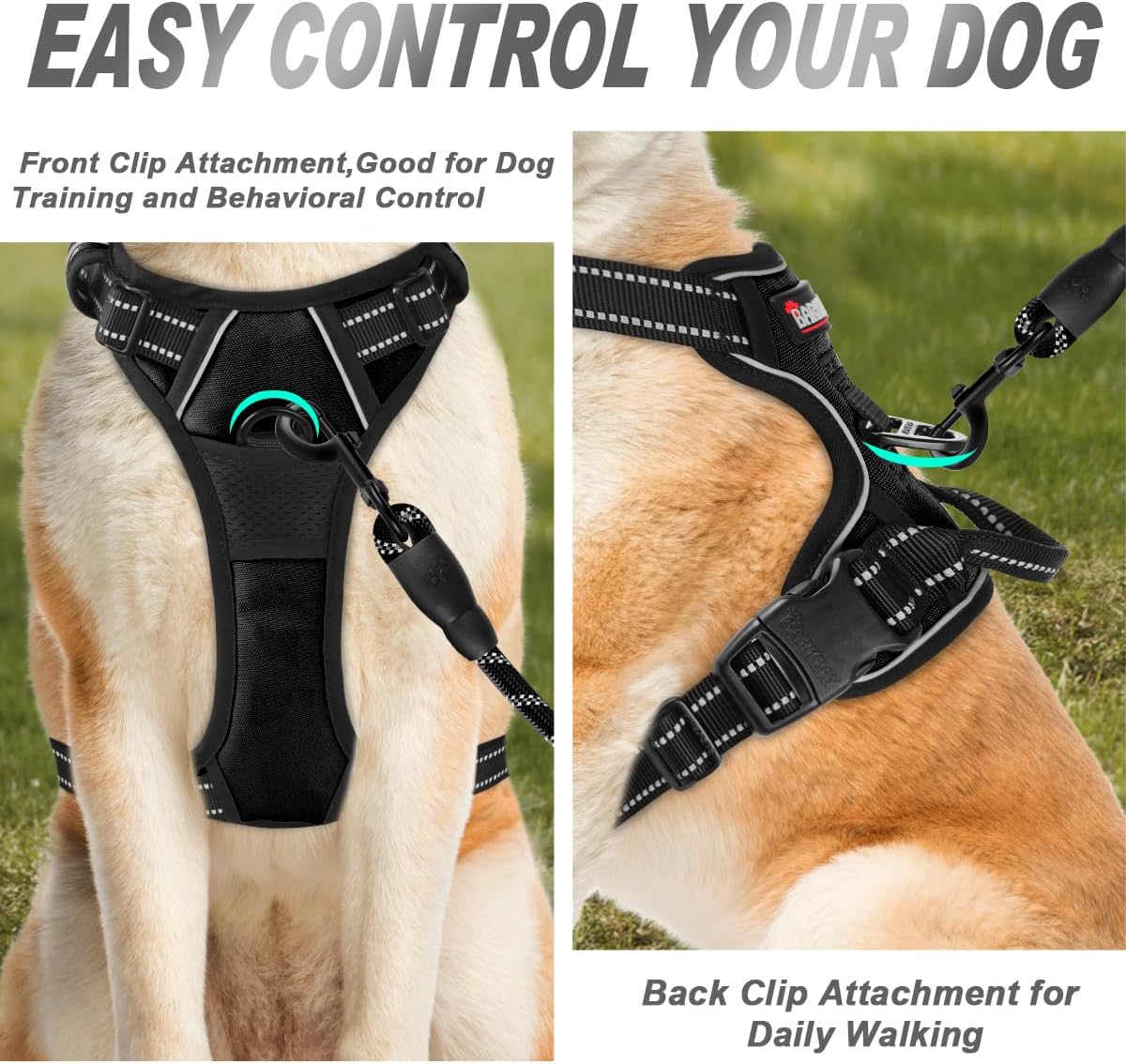
If you’ve ever grabbed your dog by the collar to stop them from lunging into traffic — and felt your stomach drop while you did it — you already understand why control hardware on a harness matters. A harness is a padded vest that distributes leash pressure across your dog’s chest and shoulders instead of concentrating it on the throat. The two main attachment points are the D-ring (the metal loop where you clip the leash for everyday walks) and the handle (the reinforced webbing loop sewn across the back of the harness that lets you physically grip and steady the dog with your hand). For small dogs, the handle is a nice-to-have. For large dogs — we’re talking 60 lbs and up — the handle is often the single feature that determines whether a $120 harness actually keeps you safe, or just looks like it does.
This guide breaks down what separates a functional handle from a decorative one, how to evaluate handle specs before you buy, and which tradeoffs matter most depending on how you actually use your dog. If you’re choosing between two harnesses right now, the framework below will give you a clear decision rule by the end.
What Makes a Handle “Functional” vs. Decorative
Here’s the problem: nearly every harness on the market above $40 includes a handle. Very few of them publish the specs that tell you whether that handle is structural.
A structural handle is one that’s independently reinforced — meaning it has its own load path sewn directly into the harness’s primary webbing, not just stitched onto the exterior fabric as an afterthought. The distinction matters because when a 90-lb dog hits the end of a short-hold grip, the force on that handle can spike to multiples of the dog’s body weight in a fraction of a second. That’s not a slow steady pull; it’s an impact load.
The markers to look for:
Bar-tack stitching at anchor points. Bar-tacking (a dense, tight zigzag stitch pattern used in load-bearing applications like climbing gear and military webbing) at each end of the handle is the most reliable visual indicator that the manufacturer treated the handle as a structural element. Julius-K9’s IDC Powerharness documentation specifically identifies bar-tacked reinforcement at handle terminations as part of their load-rating claim.
Webbing denier and material. Denier (abbreviated den or D) is the unit that measures how thick and heavy each fiber in a woven strap is — higher denier means a denser, more abrasion-resistant weave. A handle made from 1,000-denier nylon webbing behaves very differently under load than one sewn from 400-denier polyester. Ruffwear’s published specs for the Flagline and Web Master harnesses both reference high-tenacity nylon webbing in the handle construction; that language is meaningful and worth looking for in competing products.
Handle placement relative to the dog’s center of gravity. A handle positioned directly over the dog’s shoulder blades (scapulae) lets you apply downward pressure to settle the dog without torquing the spine. A handle positioned too far rearward — over the lumbar region — creates a fulcrum effect that can actually amplify forward momentum on a large dog rather than arrest it. The Whole Dog Journal’s 2024 harness fit guide specifically flags rear-biased handle placement as a common design flaw in budget large-breed harnesses.
The D-Ring Is Doing a Different Job
None of this is an argument against D-rings. The D-ring and the handle are solving different problems, and conflating them is how buyers end up disappointed.
The back D-ring is optimized for low-distraction, steady-state walking. It distributes leash tension evenly, reduces shoulder torque on the dog, and gives you good directional feedback at a relaxed pace. The front D-ring (chest attachment, found on no-pull harnesses) redirects a dog that forges forward by turning their body toward you — effective for training, but not a replacement for physical control in a genuine emergency.
The handle is optimized for instantaneous physical intervention: lifting a dog over an obstacle, steadying them at a curb, preventing a lunge, assisting a dog on an unstable surface, or holding a reactive dog close while another dog passes. It’s the difference between steering and braking.
The AKC’s harness selection guidance notes that for dogs over 60 lbs, the handle is the primary safety redundancy in high-distraction or high-traffic environments — not a secondary feature. That framing is the right one.
By the numbers:
| Scenario | Primary Control Point | Why |
|---|---|---|
| Casual trail walk | Back D-ring | Steady tension, natural gait |
| Street-crossing, traffic | Handle | Instant vertical control |
| Reactive dog, passing trigger | Handle + chest D-ring | Redirect + hold simultaneously |
| Dock, boat, or water egress | Handle | Lift assist, no leash tangle risk |
| Vehicle loading / unloading | Handle | Short-range positional control |
How to Evaluate Handle Quality Before You Buy
Most harness buyers evaluate D-ring placement and chest padding. Almost none ask the handle questions. Here’s a practical checklist to run before committing.
1. Ask where the stitching terminates. The handle should anchor into the harness’s structural spine — the continuous webbing loop that runs under the dog’s belly and over the back — not into the exterior fabric shell. If the product page doesn’t show this clearly, search for third-party fit videos. Canine Journal’s 2025 large-dog harness roundup flagged this exact issue with two mid-range harnesses that had handles stitched only to the top fabric panel, not the load-bearing webbing.
2. Check for handle rigidity. A floppy, fabric-only handle is harder to grab under adrenaline and tends to twist when loaded, concentrating stress unevenly. Handles with a stiffened core — either foam padding, a rigid insert, or doubled webbing — stay open for a reliable grip. The Julius-K9 IDC Powerharness uses a stiffened, padded handle by design; owners across aggregated reviews consistently cite this as a differentiator in reactive-dog handling.
3. Measure the handle clearance off the dog’s back. This is almost never in spec sheets, so you have to look at scaled photos or read owner accounts. A handle that sits less than 1.5 inches off the back of a large dog’s coat gives you almost no purchase — especially with a thick double coat. Ruffwear’s Web Master harness is frequently noted in owner reviews for its generous handle height, which makes it usable even on heavily coated breeds like Malamutes and Bernese Mountain Dogs.
4. Verify load rating if published. Not all manufacturers publish this, but when they do, treat it as a hard floor rather than a ceiling. Julius-K9 publishes a working-load rating for their harness system; Ruffwear references tested webbing tensile strength in their design documentation. If a manufacturer doesn’t publish any load data for a harness positioned as a control tool, that’s informative.
5. Check post-wash integrity. This one is easy to overlook. Handle stitching on budget harnesses often degrades after repeated machine washing because the thread is not color-fast or UV-stabilized. Kurgo’s Tru-Fit documentation specifies their stitching thread spec; not all competitors do. Owners of large working dogs in reviews on whole-dog-journal.com and caninejournal.com consistently note handle delamination as the primary failure mode on lower-cost harnesses — not the D-ring hardware.
Geometry Matters: Handle Position on Different Body Types
Large dogs are not a monolith, and handle position that works on one body type fails on another.
Deep-chested breeds (Great Danes, Weimaraners, Dobermans): The longer back length means a handle placed at the manufacturer’s default midpoint may land over the thoracic spine rather than the scapular region. Look for harnesses with adjustable back panels, or confirm the handle position against your dog’s actual scapular-to-lumbar measurement before ordering.
Broad-backed breeds (Rottweilers, Mastiffs, stocky Labradors): The primary issue here is handle width. A narrow handle on a broad back will twist sideways under load rather than staying upright. Wider padded handles — typically found on working-dog harnesses like the Julius-K9 or the Ruffwear Web Master — are the right geometry for this body type.
Long-bodied breeds (Basset-mixes, some Coonhounds): The lumbar overreach problem is most pronounced here. A handle positioned over the rear half of the back on a long dog creates a pivot-point effect that can actually help the dog torque away from your grip. In this case, a dual-handle harness (one over the shoulders, one over the hips) like some tactical harness designs provide is the better solution — or confirm handle position is firmly in the front third of the back panel.
The Decision Rule
If your large dog is easygoing on leash, walks mostly on uncrowded trails, and you’ve never needed to grab them in an emergency: the D-ring configuration on any well-fitted harness is probably your most important purchase variable. Optimize there.
If your dog is reactive, strong, high-drive, or you regularly navigate urban environments, waterways, vehicles, or off-leash-to-on-leash transitions: the handle is the load-bearing safety feature and should be the first thing you evaluate — not the last. Look for bar-tacked anchoring into structural webbing, a padded or stiffened grip with at least 1.5 inches of clearance, and a position over the scapular region matched to your dog’s actual back length.
At the $80–$140 price point where most large-dog harnesses live in mid-2026, there is no meaningful reason to accept a decorative handle. The harnesses that do the job — Ruffwear Web Master, Julius-K9 IDC Powerharness, Kurgo Tru-Fit with handle upgrade — are all in that range. The ones that don’t are often in the same range and are betting you won’t notice until you need to grab your dog and the handle twists in your hand.
The D-ring is where the leash goes. The handle is where the control lives. Don’t buy them backwards.