April 5, 2026 • Marisol Vane • 9 min reading time • Prices verified June 4, 2026
Dog Food Toppers Worth Adding and the AAFCO Fine Print You Should Read First
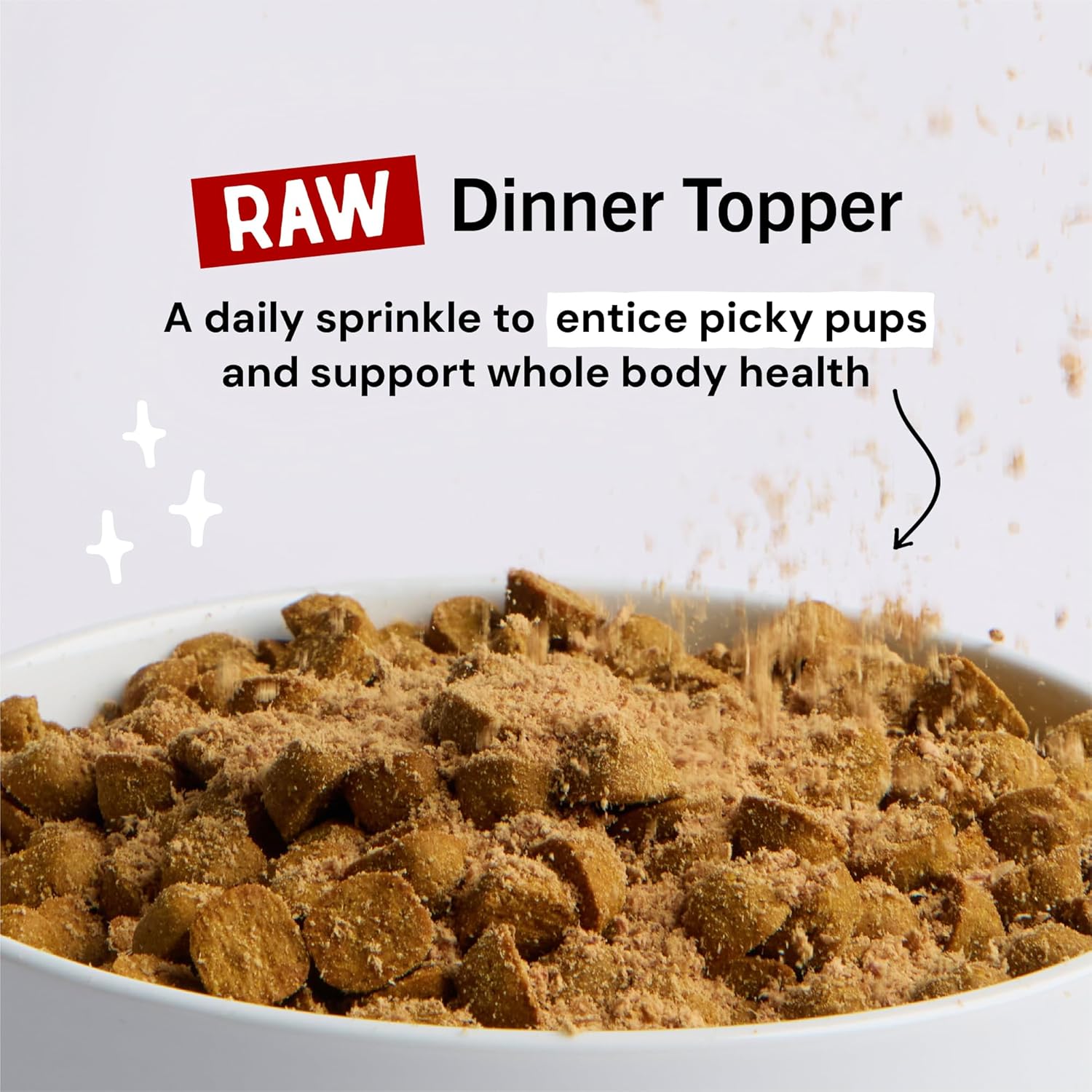
If your dog has ever turned up their nose at an otherwise solid kibble, or if you’re managing a senior dog who needs caloric density without volume, you’ve probably looked at dog food toppers — those add-on products (freeze-dried meat, bone broth, fresh-food pouches, egg powder) you spoon or crumble over the main meal. A topper is exactly what it sounds like: something added on top of the base diet. The catch is that “topper” is a marketing word, not a regulatory category. The label language underneath — specifically whether a product carries an AAFCO statement — determines whether you’re adding a nutritional complement or essentially just a flavored garnish. AAFCO, the Association of American Feed Control Officials, is the body that sets minimum nutrient standards for pet food sold in the U.S. Understanding what their label phrases actually mean is the difference between an informed buying decision and an expensive mistake.
This article breaks down the topper market by label type, shows you the math on caloric displacement (the risk nobody talks about in the marketing copy), and ends with a clear decision framework for the three most common scenarios practitioners and committed owners actually face.
| EDITOR'S PICK[Stewart 100% Beef Liver Dog Tre…](https://www.amazon.com/dp/B0002DGRSY?tag=greenflower20-20) | Mid-tierStella & Chewy's Freeze-Dried R… | Budget pickStella & Chewy's Freeze-Dried R… | |
|---|---|---|---|
| Weight | 21 oz | 3.5 oz | 3.5 oz |
| Protein % | 50% | — | — |
| Meat Source | Beef | Beef | Chicken |
| Single Ingredient | ✓ | ✗ | ✗ |
| Price | $34.98 | $9.97 | $7.98 |
| See on Amazon → | See on Amazon → | See on Amazon → |
The AAFCO Statement Is the Whole Game
Every commercially sold dog food product in the U.S. is supposed to carry one of a handful of standardized phrases from AAFCO. Toppers are no exception — except that many of them don’t carry any AAFCO statement at all, which is itself meaningful information.
Here’s what the phrases actually mean:
“Complete and balanced for [life stage] as substantiated by AAFCO feeding trials” — The product has been fed to actual dogs under controlled conditions and met AAFCO’s minimum nutrient thresholds. This is the gold standard. A topper carrying this statement can, in theory, serve as a standalone diet.
“Complete and balanced for [life stage] formulated to meet AAFCO nutrient profiles” — The product meets minimums on paper (calculated nutrient math), but hasn’t necessarily been fed to dogs in a trial. Still meaningful, but a step below feeding-trial certification.
“For supplemental or intermittent feeding only” — This is the phrase most toppers carry, and it is not a minor disclaimer. It legally signals that the product cannot sustain a dog as a primary diet. Whole Dog Journal’s evaluation of topper labeling notes that this phrase is sometimes printed in type so small it requires effort to find, yet it is the single most important piece of information on the package.
No AAFCO statement at all — This is the wild card. Some toppers, particularly bone broths, single-ingredient freeze-dried proteins, and flavored hydration boosters, carry no nutritional adequacy claim whatsoever. They are, in regulatory terms, closer to a food ingredient than a pet food. That’s not automatically bad — a plain freeze-dried chicken breast is what it says it is — but it means you cannot assume any particular nutritional profile.
PetMD’s overview of dog food toppers reinforces this hierarchy: the absence of a complete-and-balanced claim doesn’t make a product unsafe, but it does make it the owner’s responsibility to understand what they’re adding and why.
The Caloric Displacement Problem (and the Math Behind It)
This is where practitioners consistently see well-intentioned owners create problems. The concept is simple: every calorie your dog gets from a topper is a calorie that displaces something from the base diet — either you reduce the base portion (which can create nutrient shortfalls if the base is complete-and-balanced and the topper is not), or you don’t reduce the base portion (which adds total calories and risks weight gain over time).
A useful reference point is RER — Resting Energy Requirement, the baseline caloric need for a dog at rest, calculated as 70 × (body weight in kg)^0.75. A 25 kg (55 lb) dog has an RER of roughly 700 kcal/day. Maintenance for a moderately active dog is typically 1.2–1.6× RER, so call it 840–1,120 kcal/day.
By the numbers — a 25 kg active dog:
- Daily maintenance target: ~1,000 kcal
- Typical premium dry kibble: 360–420 kcal/cup
- A 2 oz freeze-dried beef topper: ~120–180 kcal (varies significantly by brand)
- Caloric share of topper at 2 oz: roughly 12–18% of total daily intake
That 12–18% matters because AAFCO’s complete-and-balanced formulations are calibrated to meet minimums at full feeding rates. If a topper is replacing 15% of the base diet’s calories but providing no meaningful contribution to calcium, phosphorus, or key vitamins, the net effect on a dog eating exactly at maintenance is a 15% dilution of those nutrients. VCA Hospitals’ nutritional reference material notes that calcium and phosphorus imbalance is one of the more common diet-induced issues seen in dogs whose owners supplement heavily without professional guidance, particularly in large-breed puppies where Ca:P ratio (the proportion of calcium to phosphorus, ideally between 1:1 and 2:1 for adults) is critical.
The practical rule: if a topper is “for supplemental or intermittent feeding only” and you’re feeding it daily, keep the topper’s caloric contribution under 10% of total daily intake. At that level, nutrient dilution from the base diet stays within margins that a complete-and-balanced kibble can absorb. Above 10%, you’re in territory where the topper’s own nutritional profile starts to matter — and most toppers without a complete-and-balanced claim don’t have profiles designed to hold up under scrutiny.
Reading the Ingredient and Guaranteed Analysis Panels
Beyond the AAFCO statement, two panels tell you most of what you need to know.
The ingredient list follows descending-weight order before cooking. “Beef” listed first sounds premium; in a high-moisture product (bone broth, wet topper), water weight inflates that position. “Beef broth” or “chicken” in a broth-based topper may mean you’re primarily buying water with flavor. That’s not fraud — hydration toppers have legitimate uses for dogs who are picky drinkers — but it’s not a protein supplement. Tufts University’s Your Dog Magazine has specifically flagged this moisture-weight issue as a common source of consumer confusion in topper marketing.
The guaranteed analysis gives you minimum crude protein and fat percentages, and maximum crude fiber and moisture. For moisture-rich toppers, always convert to a dry-matter basis before comparing across products. The formula: (nutrient % ÷ (100 − moisture %)) × 100. A topper showing 8% protein at 80% moisture is actually 40% protein on a dry-matter basis — comparable to a quality freeze-dried product. Without this conversion, wet and dry products are not meaningfully comparable.
Freeze-dried single-ingredient toppers (pure beef liver, salmon, chicken hearts) tend to score well on this math because moisture is typically below 5%, and the protein content reflects actual tissue concentration. The tradeoff is cost per ounce and the fact that organ meats in particular — especially liver — are nutrient-dense enough that overfeeding creates genuine toxicity risk. Vitamin A toxicity from excessive liver feeding is documented in veterinary literature; VCA Hospitals notes that liver should generally not exceed 5% of total diet by weight on a regular basis.
Category-by-Category Topper Breakdown
Freeze-dried meat and organ toppers (e.g., Vital Essentials, Stella & Chewy’s Meal Mixers, Primal Freeze-Dried Nuggets used as topper portions): High protein density, minimal processing, strong palatability. Stella & Chewy’s Meal Mixers and Primal both carry AAFCO complete-and-balanced statements when used at full feeding rates, which gives you the flexibility to use them as a partial meal replacement without the nutrient-dilution concern. Owners across aggregated reviews consistently cite palatability improvement as the primary win; reviewers at Whole Dog Journal have rated the freeze-dried category as the most nutritionally transparent of the topper options, largely because the guaranteed analysis is easier to interpret without moisture distortion.
Bone broths and hydration toppers (e.g., The Honest Kitchen Instant Bone Broth, Primal Bone Broth): Typically no AAFCO statement. Function is palatability and hydration, not nutrition. Sodium content varies widely — relevant for dogs with cardiac or renal concerns. Read the sodium line on the guaranteed analysis; some broths are formulated to be low-sodium for exactly this reason.
Fresh and refrigerated toppers (e.g., The Farmer’s Dog Topper, Ollie Toppers): These sit at the premium end. The Farmer’s Dog topper line, as of 2025–2026, carries complete-and-balanced claims for adult maintenance under AAFCO feeding trial protocols — one of the few wet toppers in the category where you can legitimately use a larger portion without worrying about nutrient dilution. Pricing runs $2–$4 per serving depending on dog size and subscription tier, which is a meaningful cost consideration for multi-dog operations.
Egg and whole-food powders (e.g., The Honest Kitchen meal boosters, Dr. Harvey’s Veg-to-Bowl): Variable AAFCO status — check per product. Some are formulated to be mixed with protein and water as a complete diet; used as a topper in smaller amounts, they function as a fiber and micronutrient supplement. Ingredient transparency is generally high in this category.
Decision Framework: If X, Then Y
If your dog is healthy, eating a complete-and-balanced base diet, and you want to improve palatability: Use a freeze-dried or broth topper at under 10% of daily calories. AAFCO statement is a nice-to-have, not required at this use level. Focus on ingredient simplicity and sodium content.
If you’re managing a dog with a diagnosed condition (renal disease, cardiac disease, food allergy under elimination trial): Do not add any topper without veterinary sign-off. The sodium in broths and the novel proteins in freeze-dried toppers can materially interfere with therapeutic diets. This is not a category where marketing claims are sufficient due diligence.
If you want to use a topper as a meaningful partial meal replacement (10–30% of daily calories): The topper must carry a complete-and-balanced AAFCO statement. Full stop. “Supplemental or intermittent feeding only” products are not designed to hold up nutritionally at this use level. In this scenario, Stella & Chewy’s Meal Mixers, Primal freeze-dried, or The Farmer’s Dog topper are the categories worth evaluating — not bone broth.
If you’re a trainer or kennel operator feeding multiple dogs at volume: The cost-per-kcal math shifts significantly. Freeze-dried toppers at full premium retail ($18–$28 for a 6 oz bag) pencil out to $3–$5 per 100 kcal — comparable to fresh-food subscription pricing. At volume, a negotiated auto-ship arrangement with Chewy or a direct wholesale relationship with a brand like Primal is worth the conversation. The nutritional calculus above doesn’t change at volume, but the purchasing model does.
The topper market is genuinely useful — there are real dogs eating better, drinking more water, and finishing meals they’d otherwise refuse, because of a well-chosen topper. The AAFCO fine print isn’t there to complicate your life; it’s the fastest way to cut through the marketing and know exactly what you’re buying before it goes in the bowl.